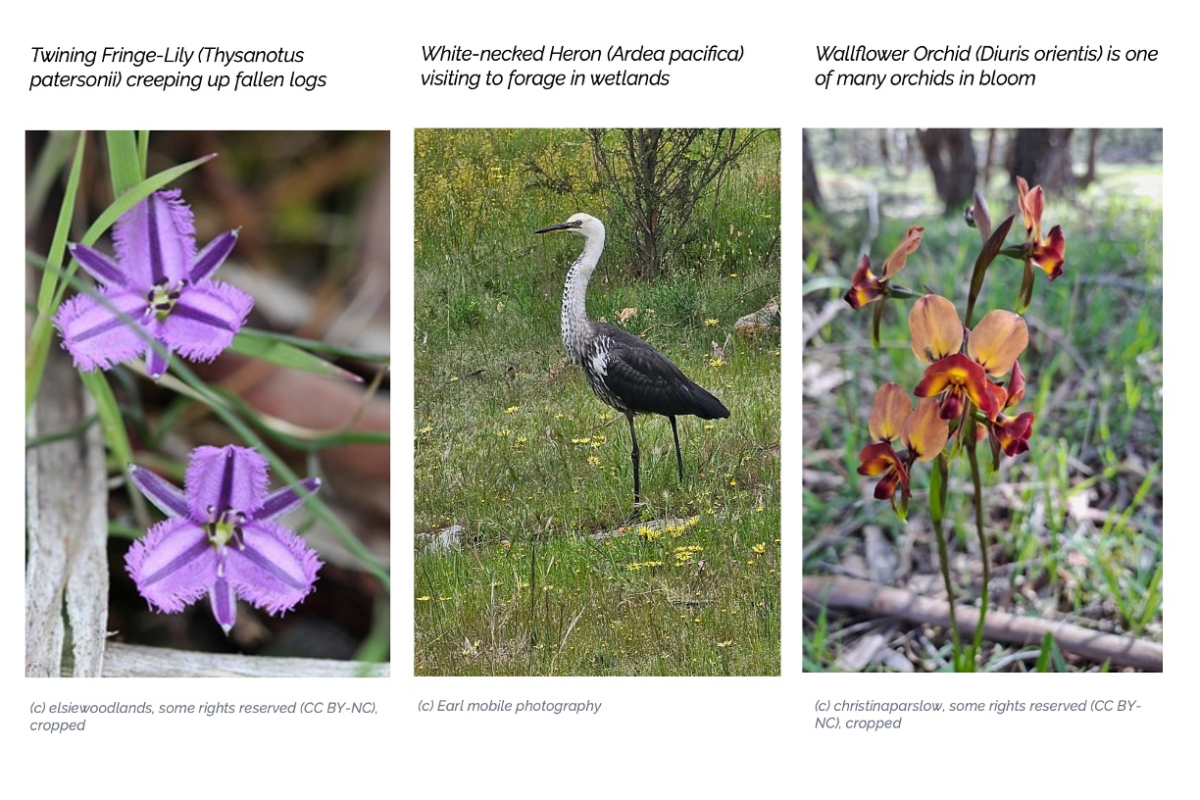
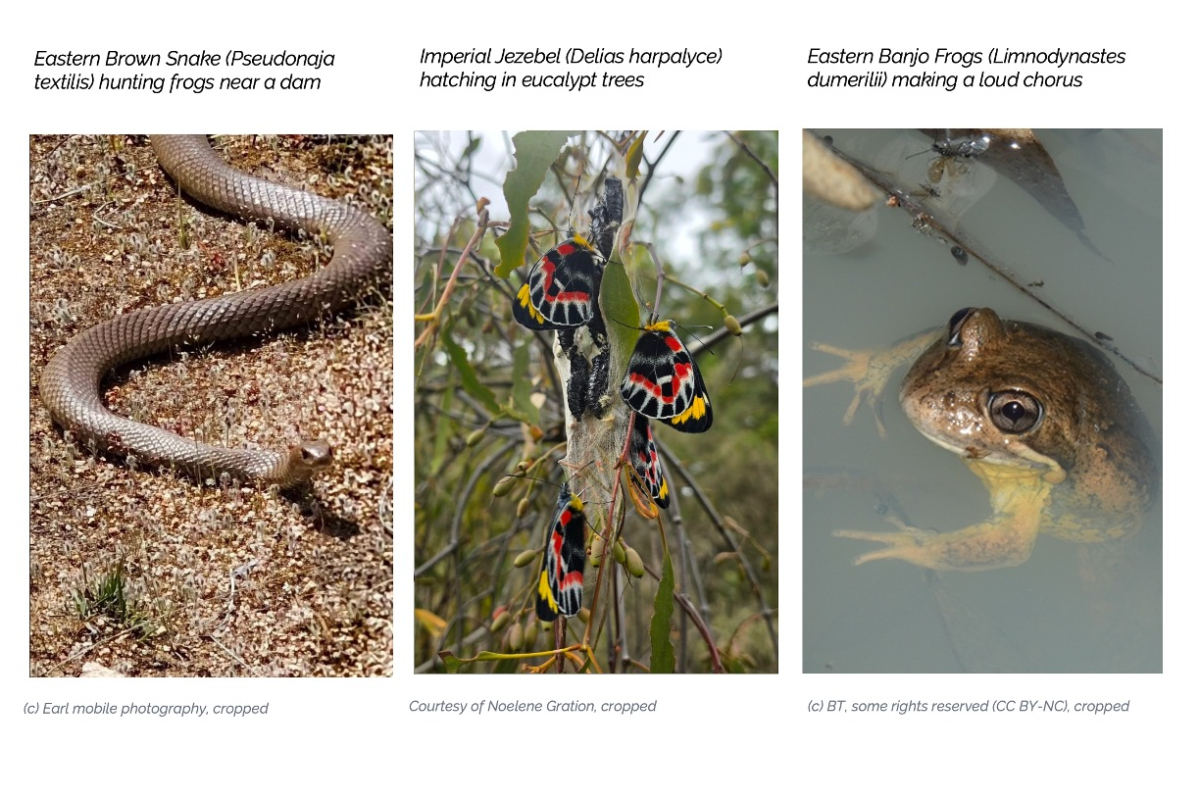
Spring (September to November) is known as Petyan – season of wildflowers in the Brambuk seasonal cycle of the Gariwerd region. In our local area, this means:
Many locals and visitors have captured images in Black Range during Petyan, either sharing on the iNaturalist platform or with us directly at [email protected]. The very wet winter means water is still holding in small creeks and dams through the Range, with birds, frogs, flowers and reptiles in plentiful supply this year. Watch out for snakes, especially around water!
24 October 2026 (Saturday) - Mini workshop on weedy plants: non-chemical and alternative approaches 10:00am-12:00pm (see details below)
21 November 2026 (Saturday) - BRLMG Annual Gathering + AGM, Bunjils Shelter Reserve 10:00am-2:00pm (see details below)

See the attached flyer for details
We have rescheduled a mini-workshop on how to work with plants we consider weeds in the Black Range. Join us for a morning exploring ‘less desirable plants’, how to consider them through ‘reading the landscape’ and as part of a plant succession system, together with non-chemical and alternative ways to remove or treat them.
We’ll have a conversation to discover or share what those of us who attended the field day learned from Gwyn Jones’ visit in September. We’ll go through a plant succession in our context, ‘reading’ the landscape and soil conditions, considering plant function, as well as erosion control for better hydration.
Then we’ll drill down to approaches used by local landholders with Neil Marriott describing mosaic burning, Mick Douglas with wick-wiping and flame-torching, Tanya Coburn talking about solarisation, observation and experimentation.
You are welcome to bring any favourite tools, implements and approaches for addressing weeds for a show and tell over a cuppa and morning tea.
Chair Mick is currently assembling a line of up engaging speakers in relation to topics as diverse as indigenous culture, seed collection and propagation and we'll be hearing from Julie Groce from Parks Victoria. Please come along and bring a plate to share. After guest presentations, we will move on to reporting on the year's activities and election of office bearers.
**CALL FOR NEW COMMITTEE MEMBERS AND PROJECT TEAM MEMBERS**
Sadly, both Mick (Chair) and Fernanda (Vice Chair) need to step off the committee the end of 2026. We are looking for members to join the committee who have an interest in contributing to the leadership or administration of the group. We also need more hands on deck to cover the many tasks that Mick used to lead. For example, organising working bees, shadowing Mark's IPA work, managing the group's library of assets, to name a few! Please reach out to Mick, Celia, Fernanda or Mike if you are interested to join our efforts in any capacity.
By Tanya Coburn
I’ve just been scything back Pampas lily of the valley (Salpichroa origanifolia), and deadheading some remaining One-leafed Cape tulip flowers (Moraea flaccida). As I came in to write this, I passed lots of healthy mounds of grey-green foliage covered with yellow daisies, and remembered the endless daisy chains my friends and I made as children from Capeweed flowers (Arctotheca calendula). I’m also wondering about twisting twine from the dried leaves of Cape Tulip plants we have dug up.
Which brings me back to the field day, where Gwyn Jones invited us to think about the form and function of weeds, and to consider not just what they were doing above ground but their root systems and bulbs or corms as well. For weeds grow to fulfil some vacancy in the natural world; covering bare ground in disturbed areas, providing biomass which contributes to the humus in the soil, addressing a soil imbalance by offering something which helps natural recovery (as Capeweed addresses an imbalance of nitrate, for example), providing drought resistant plant covering in our drying landscape. Their roots, like the long taproots of thistles and some brassica species can serve to aerate soil. How or whether we intervene depends on how we perceive their presence in the landscape and what we sense is needed to allow other plants to succeed them.
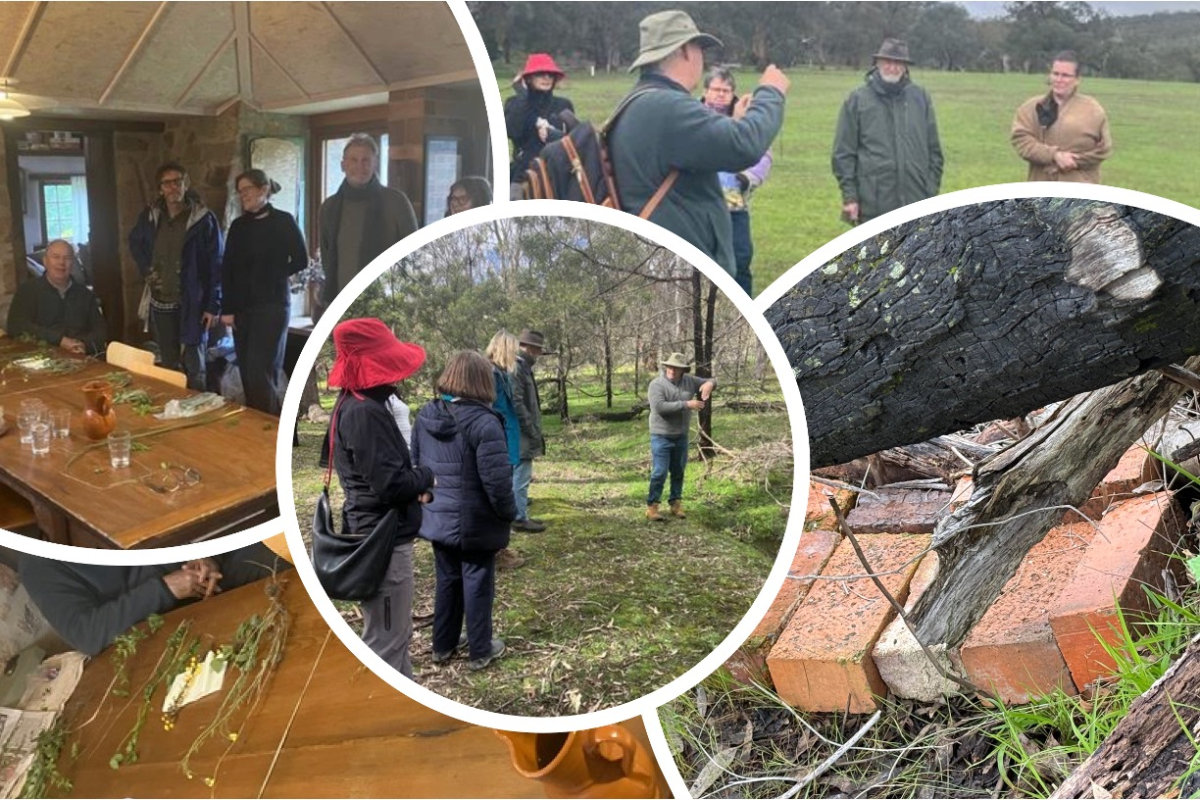
As landholders caring for land where we want to increase biodiversity, resilience and conservation, whtether we consider a species problematic or part of the healing of that system depends on what we want to achieve in that part of our landholding where particular unwanted plants persist. For many of us, seeing more biodiversity of indigenous species is a desired outcome, so we will observe the behaviour of less desirable species with concern. Whatever our intent, Gwyn invites us to think more deeply about the context of a plant and to consider its role in an order of succession from the most simple to the more complex or more productive and more desired plants in a particular plant community.
Gwyn was also keen to get us thinking about preventing erosion and increasing the water-holding capacity of land, especially close to creeks, streams and watercourses, by holding back water in chains of ponds to allow greater hydration and slow the movement of water.
How is this perspective changing my behaviour on our landholding? As well as my other experiments, I’m thinking about applying a carbohydrate solution of one tablespoon of sugar per watering can, to emerging Capeweed next year to see whether that deters them and encourages other species. We’re also looking at the erosion in the creek which runs through part of our landholding, and with Gwyn’s help, have introduced some small ‘leaky weirs’ made from bricks, stones and organic matter. I’m continuing to look at weedy plants with curiosity and wonder, ‘What are you contributing and why are you here?’ If I’m concerned about their capacity to spread, I’m also considering how to reduce them by changing the context, or removing them in ways that serve nature.
Thanks to Gwyn Jones for his passion and enthusiasm and to all who attended the field day in September. We’re having a post field day weed exploration on 24 October from 10-12 if you’d like to find out more - details in the article above!
A new regional initiative is bringing together landholders, Landcare groups and government agencies to improve how feral deer are monitored and managed across the Grampians-Gariwerd landscape.
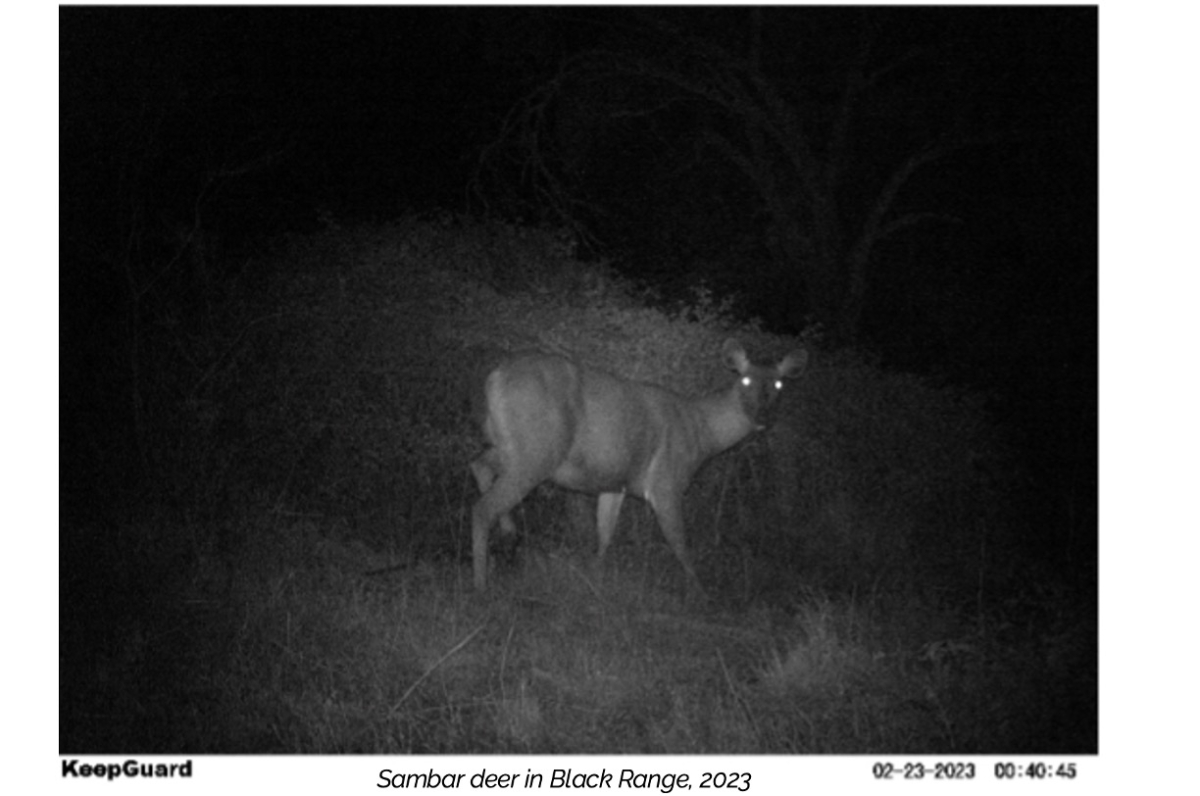
The 14-month Grampians-Gariwerd Deer Coordinator Trial, hosted by Project Platypus Landcare Network, is focused first and foremost on monitoring: building a better picture of where deer are moving across public and private land, particularly along waterways, biolinks and other movement corridors. An important part of the project is a network of AI-assisted wildlife cameras, with observations feeding into a shared map to help inform future management.
The project builds on work already undertaken in the Black Range. Since 2023, Parks Victoria and BRLMG have coordinated seasonal deer control across public land and participating private properties, with around 22 landholdings covering approximately 2,140 hectares involved to date. Participation by private landholders has been by written permission.
Without intervention, deer numbers can grow by about 33% per year (ie 30 deer can become nearly 500 in just 10 years). Fallow deer consume the equivalent amount of vegetation as 1.8 – 2.3 sheep; allowing numbers to grow naturally would put enormous pressure on flora and fauna in fragile ecologies like Black Range. Some landholders have commented that there now seems to be less deer activity since the control program started.
BRLMG is now working with Project Platypus Landcare Network and the new Deer Coordinator on the next phase. Mark Farrer is coordinating BRLMG’s involvement, including opportunities to strengthen monitoring across the Range and connect interested landholders with the broader program.
Landholders can choose whether they wish to be involved. If you have deer activity on your property, are interested in hosting a monitoring camera, or would like to know more about participating in future coordinated activities, please contact Mark on 0491133779.
Spring growth is well underway following the recent rain, which also means it is a good time to keep an eye out for some of the Black Range’s priority weeds.
The Landmate Crew, landholders and Council roadside contractors have already been working on Bridal Creeper, One-leaf Cape Tulip and Boneseed. Other weeds to watch for through spring include Wild Watsonia, Paterson’s Curse, Horehound, Gorse and African Weed Orchid.
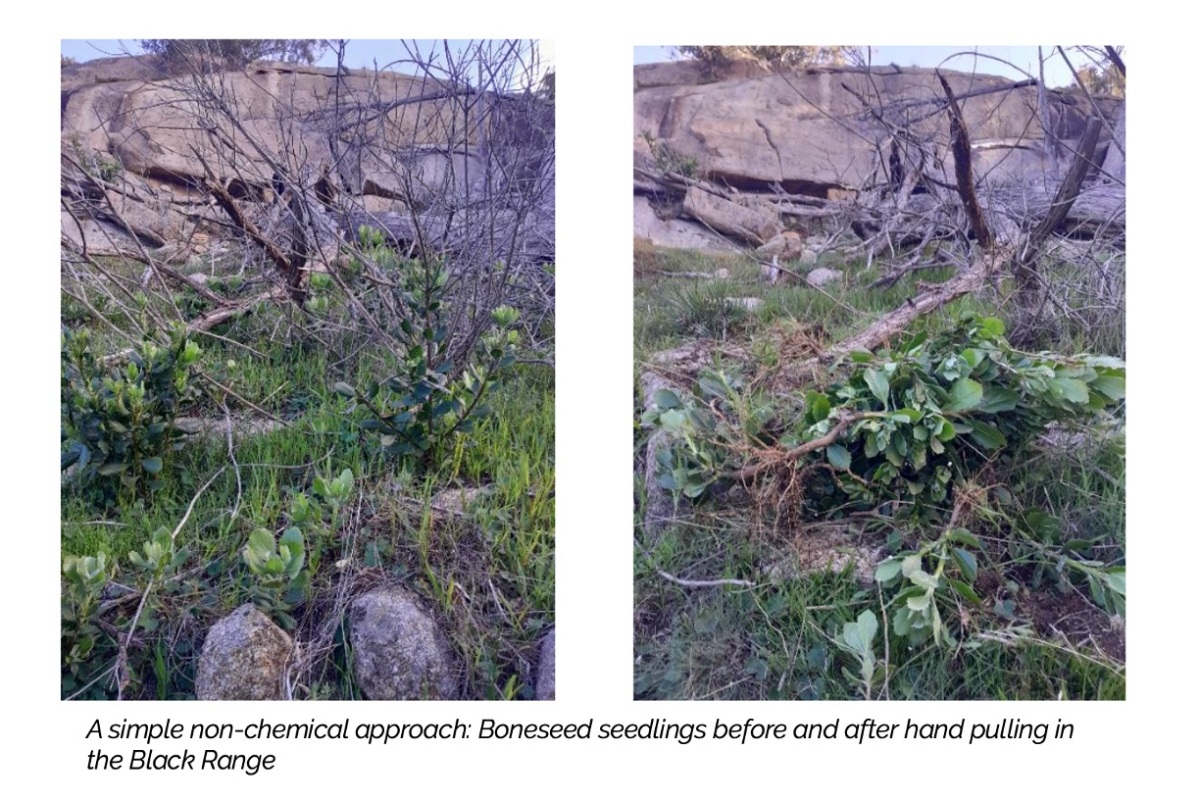
Not all weed control needs to involve chemicals. For small infestations, particularly around the home block or sensitive bush areas, hand pulling or digging can be useful where the whole plant and, where appropriate, its underground parts can be removed without causing excessive soil disturbance. Young Boneseed is a good example: seedlings can often be hand-pulled when the soil is damp.